What Database Does ChatGPT Use? How OpenAI Scales PostgreSQL
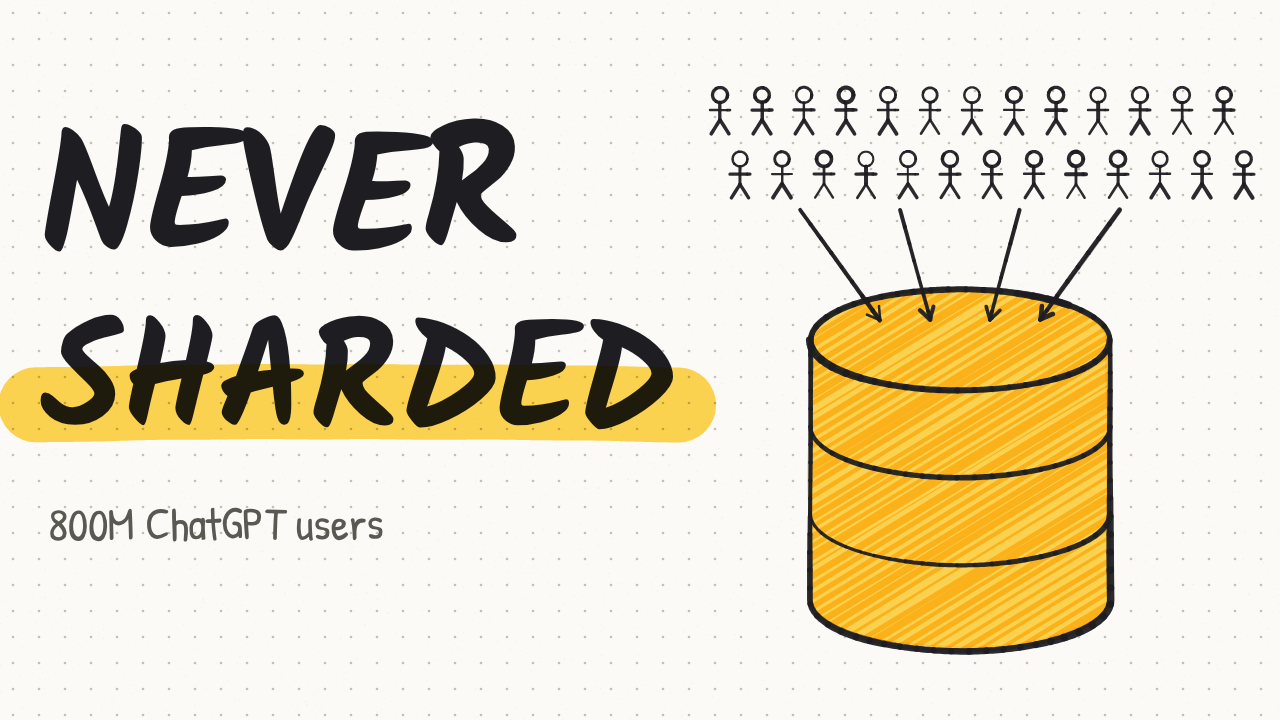
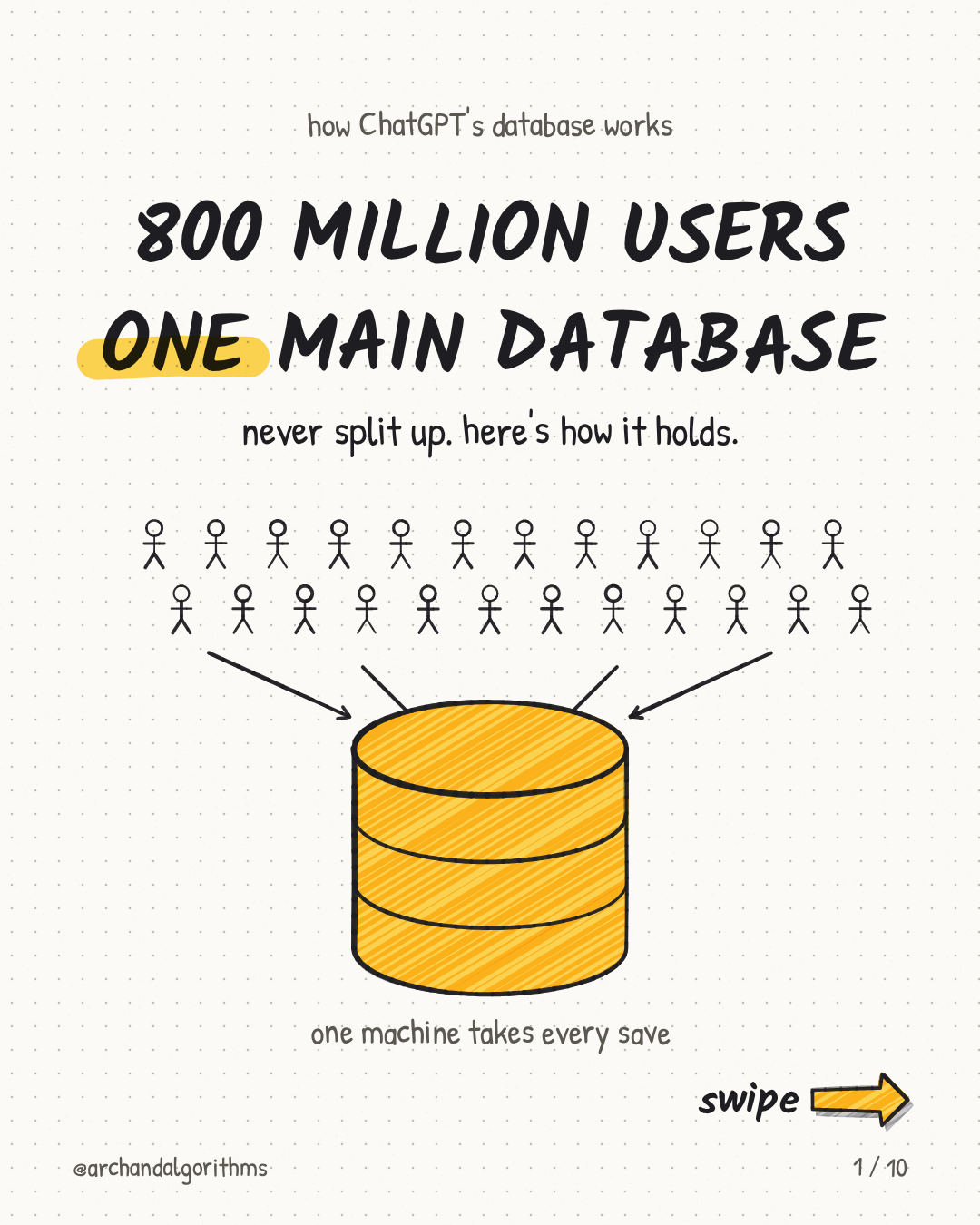
800 million people use ChatGPT. The main Postgres database behind it has one single machine that takes every write sent to it.
If you've done any system design prep, your instinct is the same as mine was: that database should have been split up (sharded) a long time ago. OpenAI never split it. And it doesn't fall over.
I read OpenAI's engineering post on this, "Scaling PostgreSQL to power 800 million ChatGPT users" (Bohan Zhang, January 2026), and drew the whole thing on one page. Every number below comes from that post. Where something is my opinion, I say so.
The short version
- One main Postgres machine takes all the writes. A backup waits on standby.
- Nearly 50 copies (read replicas) in regions around the world answer the reads, and a cache in front answers most of them.
- The load grew more than 10x in one year, to millions of queries per second.
- Four habits keep the one writer alive: push reads away, guard the writer, reuse connections, put limits everywhere.
- The result: five nines of availability and one top-severity Postgres incident in 12 months.
The setup
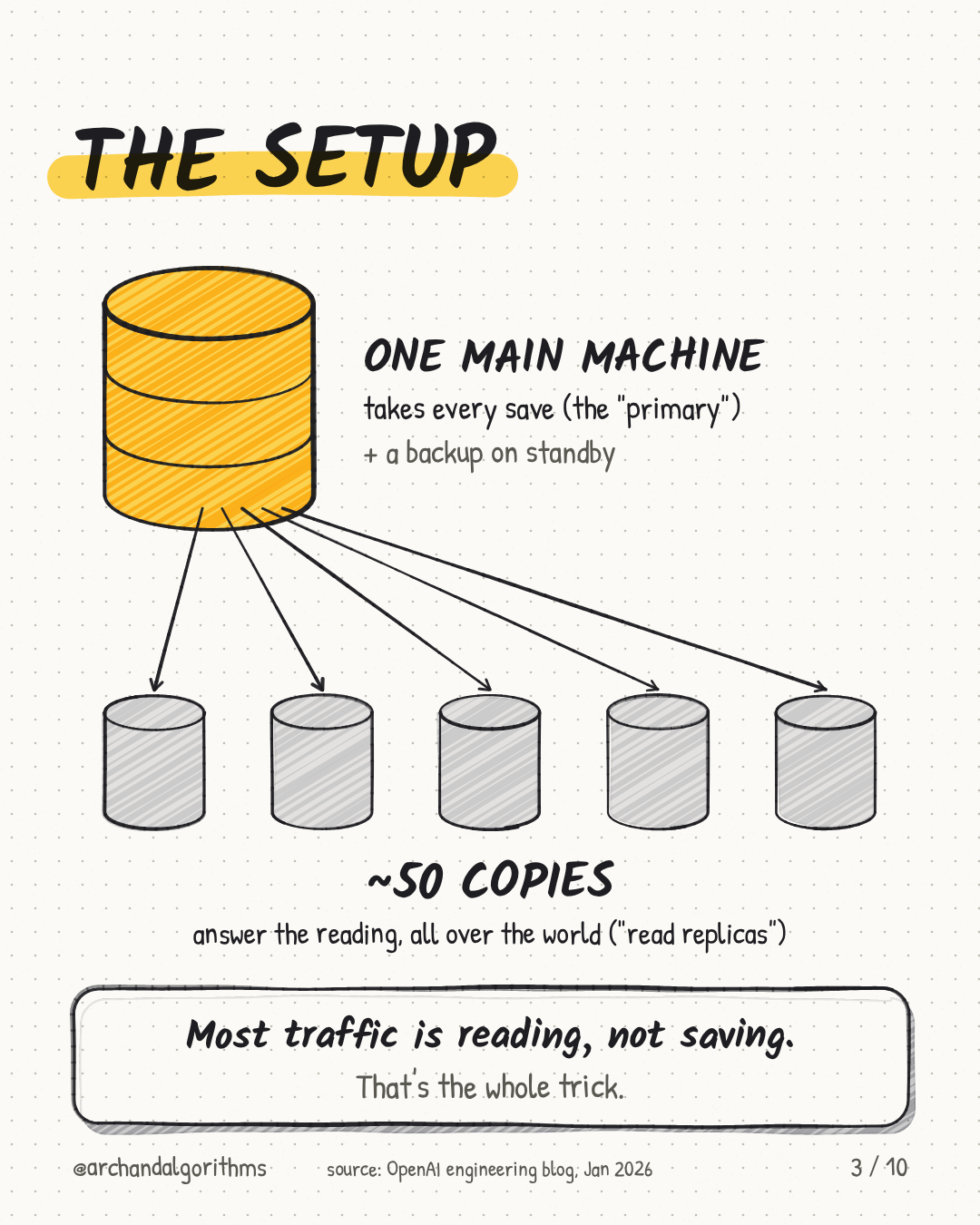
Here's the shape in plain words first.
There is one main machine that accepts every save. Engineers call it the primary. It runs on Azure's managed PostgreSQL (flexible server), with a hot standby: a second machine that stays in sync and takes over if the primary dies.
Every change on the primary is copied to nearly 50 other machines, spread across multiple regions. These are read replicas. They can answer questions ("show me this conversation") but they don't accept saves.
In front of all of that sits a cache, a fast shortcut that remembers popular answers, so most reads never touch a database at all.
The reason this works at all is one line in OpenAI's post: their workloads are primarily read-heavy. People read far more than they write. Reads can be spread across 50 machines. Writes to this database can't, so every one of them still lands on the primary.
The pressure
That load isn't standing still. OpenAI says it grew more than 10x over the past year, and the system now handles millions of queries per second.
So the real question isn't "how does one database serve 800 million people". It's "how do you stop one writer from getting crushed while traffic multiplies?" Their answer is four habits.
Habit 1: Push reads away from the primary
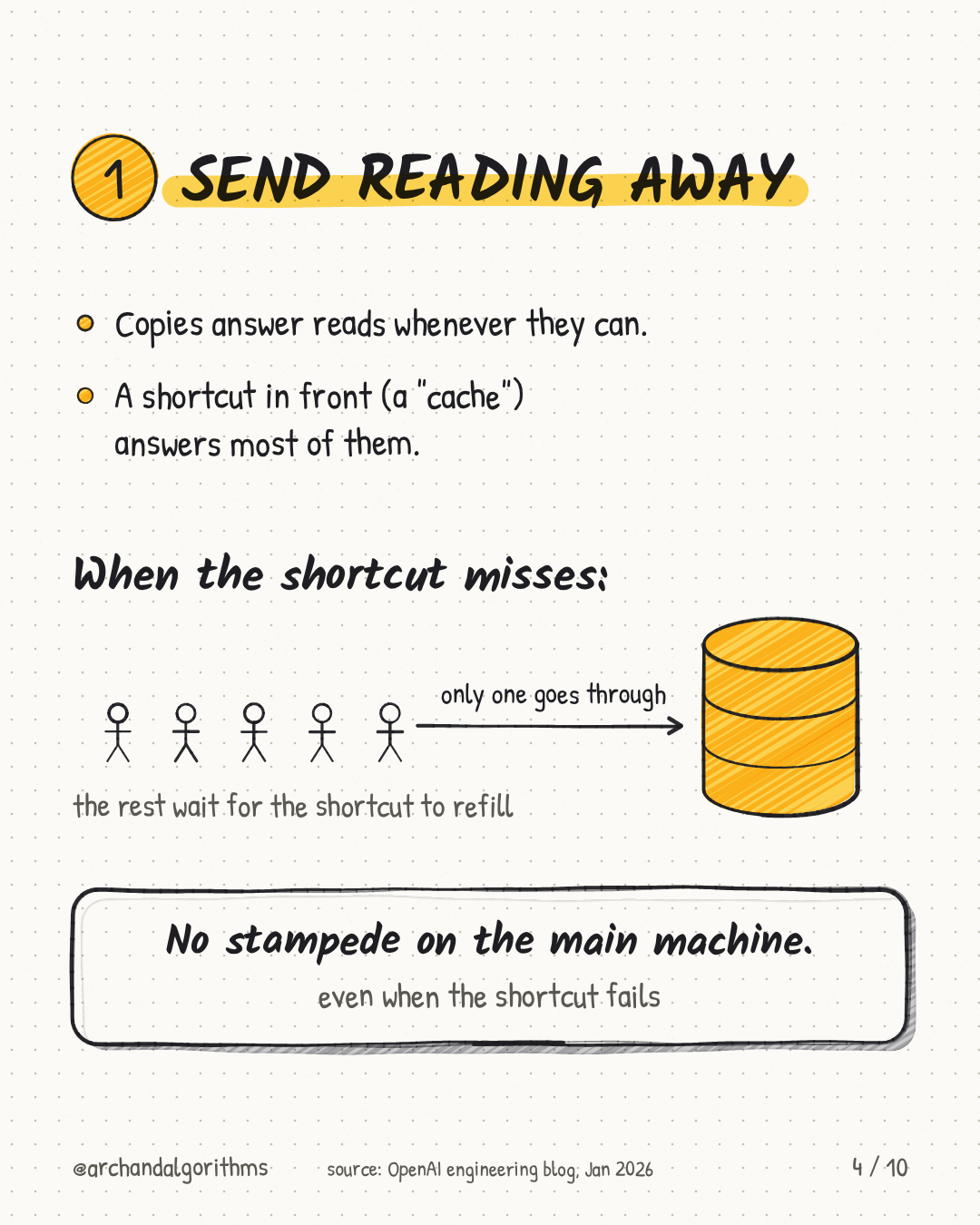
Reads go to replicas wherever possible, and the cache serves most of the read traffic.
The clever part is what happens when the cache misses. Imagine a popular item drops out of the cache. Thousands of requests ask for it at the same moment, they all miss, and they all run to the database together. That's a cache stampede (also called a thundering herd), and it can flatten a database that was perfectly healthy a second earlier.
OpenAI uses cache locking (leasing): when requests miss on the same key, only one of them goes to Postgres to fetch the data. Everyone else waits for the cache to refill. One trip instead of a flood.
Interview tip (my take): if you put a cache in your design, say what happens when it misses or fails. "One request per key refills it, the rest wait" is exactly the answer interviewers want to hear.
Habit 2: Guard the one writer
Since every write lands on one machine, OpenAI works hard to send it fewer writes:
- Write-heavy work that can be split moves out, to sharded systems such as Azure Cosmos DB.
- They fixed bugs that caused redundant writes, where the app saved the same data more than once.
- Big bulk updates (backfills) are rate-limited, so a background job can't swamp the primary.
- No new tables are allowed on this Postgres. New workloads default to the sharded systems instead.
This is the part people miss. OpenAI did shard. Just not this database. They moved out the work that was easy to split and kept the hard-to-split core on one primary.
Habit 3: Reuse connections
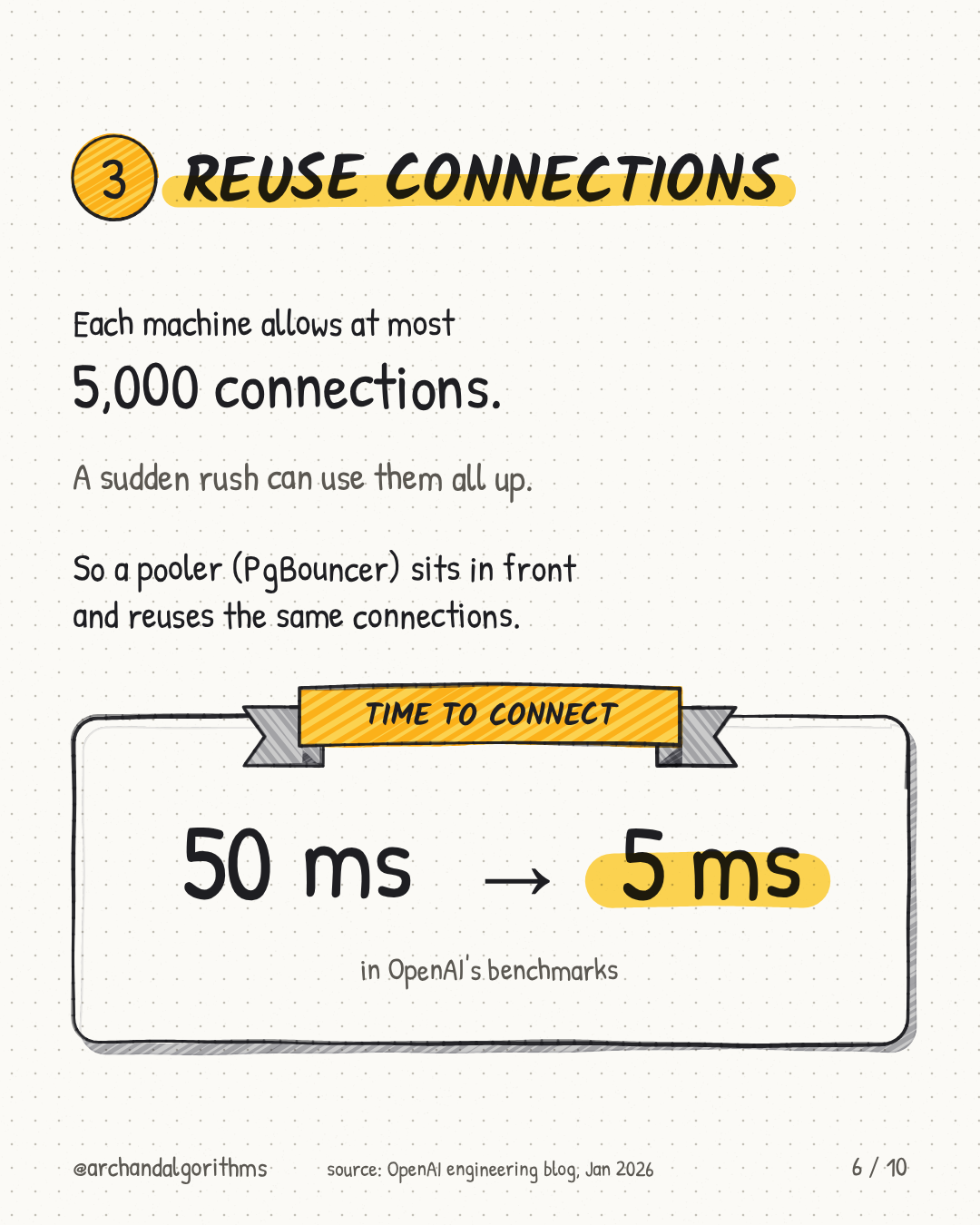
Every app server that talks to Postgres opens a connection, and opening one isn't free. Azure's Postgres allows 5,000 connections per instance. A sudden spike of new servers or retries can use them all up, and then nobody can connect.
So OpenAI puts PgBouncer, a connection pooler, in front of the database. Instead of every request opening its own connection, the pooler keeps a set of connections open and hands them out. In OpenAI's benchmarks, the average time to connect dropped from 50 ms to 5 ms.
Habit 4: Put limits everywhere
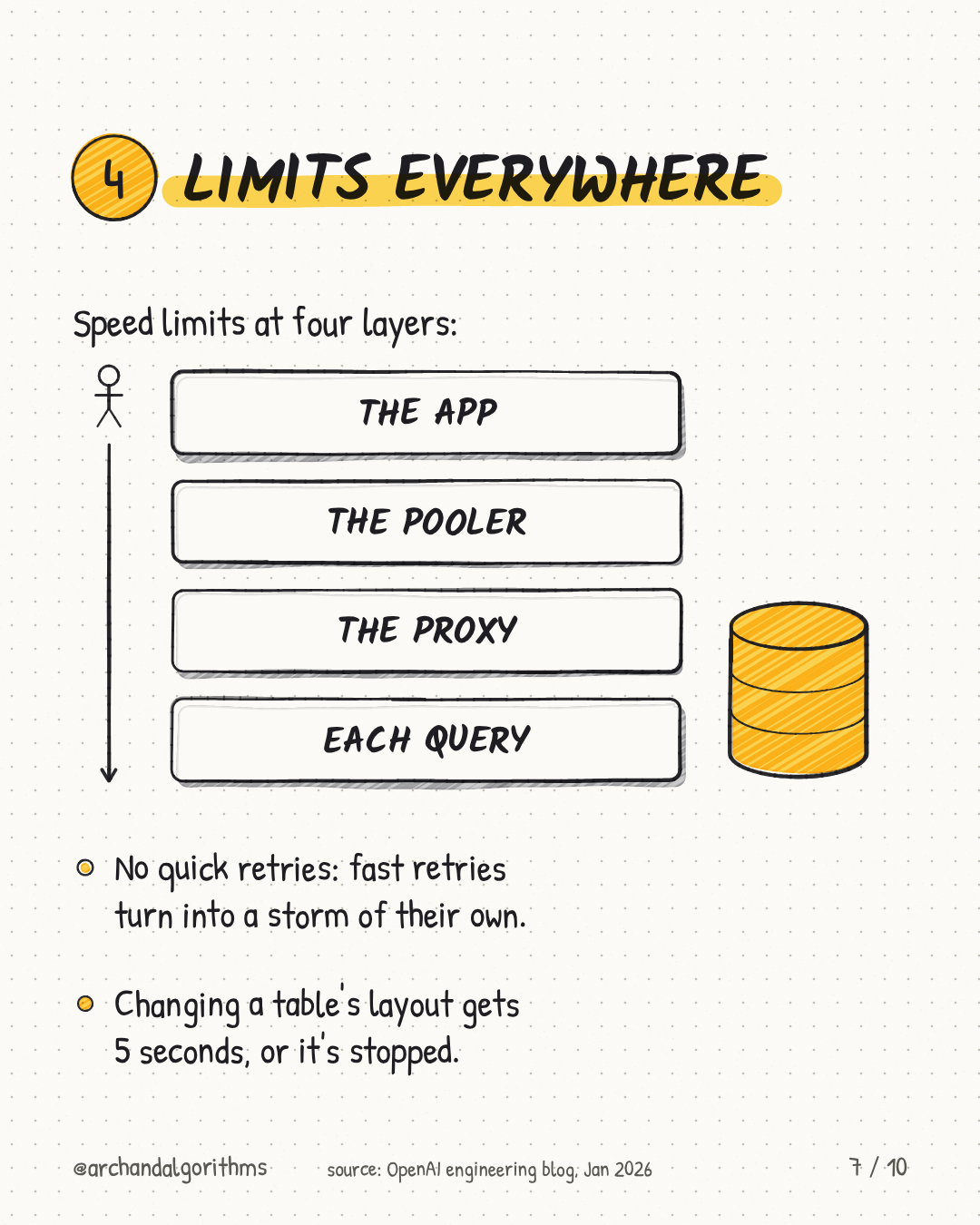
Rate limits sit at four layers: the application, the connection pooler, the proxy and the individual queries. If one layer lets too much through, the next one catches it.
Two smaller rules matter a lot:
- No overly short retry intervals. When something fails, clients retry. If they all retry instantly, the retries become a second wave of traffic, often bigger than the first. Spacing them out stops a small failure from turning into a storm.
- Schema changes get a strict 5-second timeout. Changing a table's structure can lock it. If the change can't finish in 5 seconds, it's stopped, instead of freezing writes for everyone.
The result
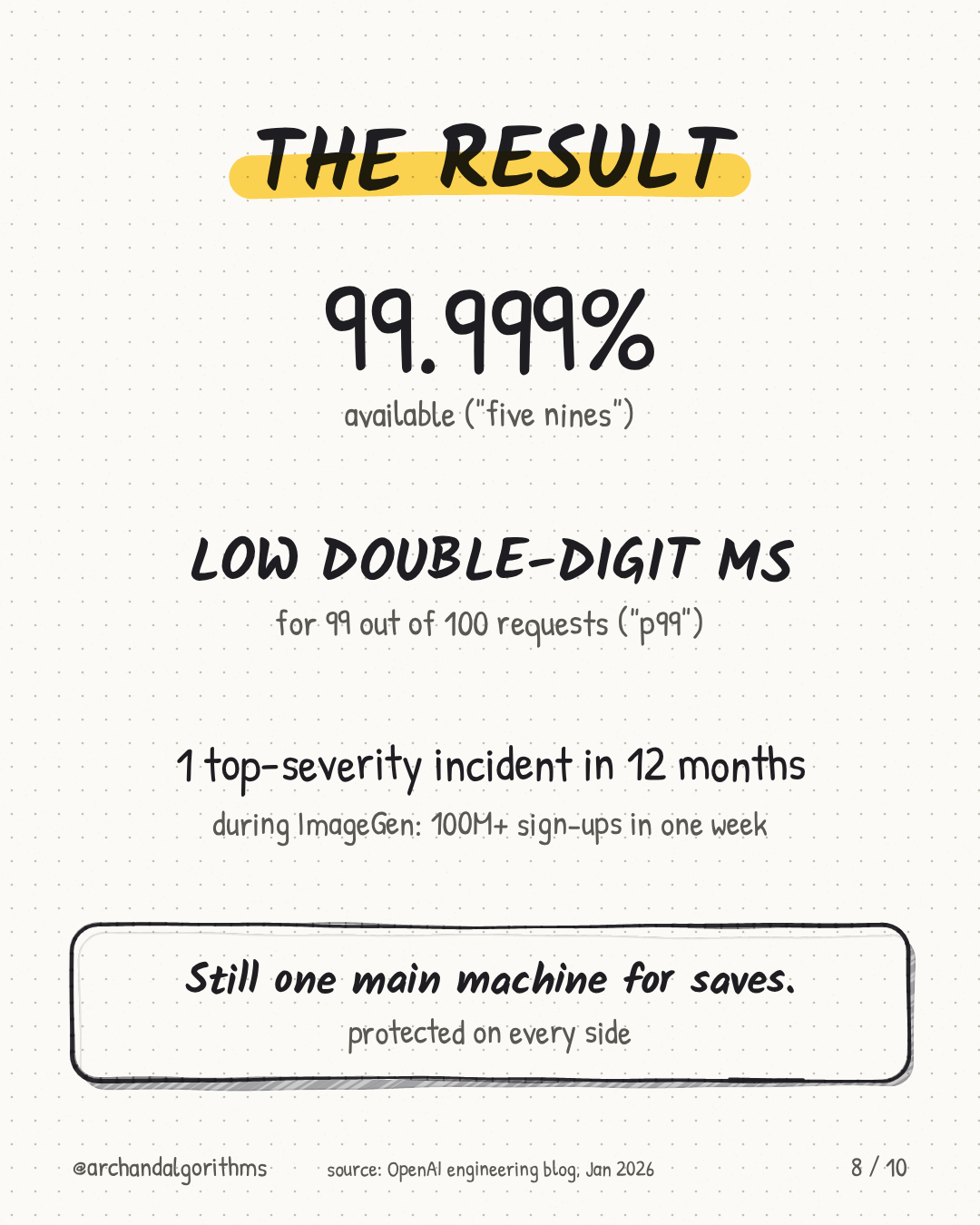
According to OpenAI's post:
- Low double-digit millisecond p99 latency on the client side. In plain words: 99 out of 100 requests come back within low double-digit milliseconds. Tens, not hundreds.
- Five nines of availability (99.999%).
- One top-severity (SEV-0) Postgres incident in 12 months. It came during the ImageGen launch, when over 100 million new users signed up in a week and writes jumped more than 10x.
So why not just shard it?
OpenAI answers this directly. Sharding this Postgres would mean changes to hundreds of application endpoints and could take months or even years. With a read-heavy workload and all the habits above, the single primary still has room to grow.
They're not ruling sharding out for the future. It's just not a near-term priority.
What I'd take into a system design interview
This part is my opinion, not OpenAI's:
- Ask for the read/write ratio before you shard. A read-heavy system can go much further on one primary than most people assume. Replicas and a cache scale reads; only writes force a split.
- Protect the single writer on purpose. Move the easy-to-split write traffic elsewhere, kill duplicate writes, throttle background jobs.
- Name the failure modes. Cache stampede, connection storm, retry storm. Each one has a small, specific fix: one request per key, a pooler, retries spaced out.
- Sharding is a cost, not a badge. It buys write capacity and charges you complexity in every part of the app. OpenAI paid that cost only for the work that was cheap to move.
The whole thing on one page
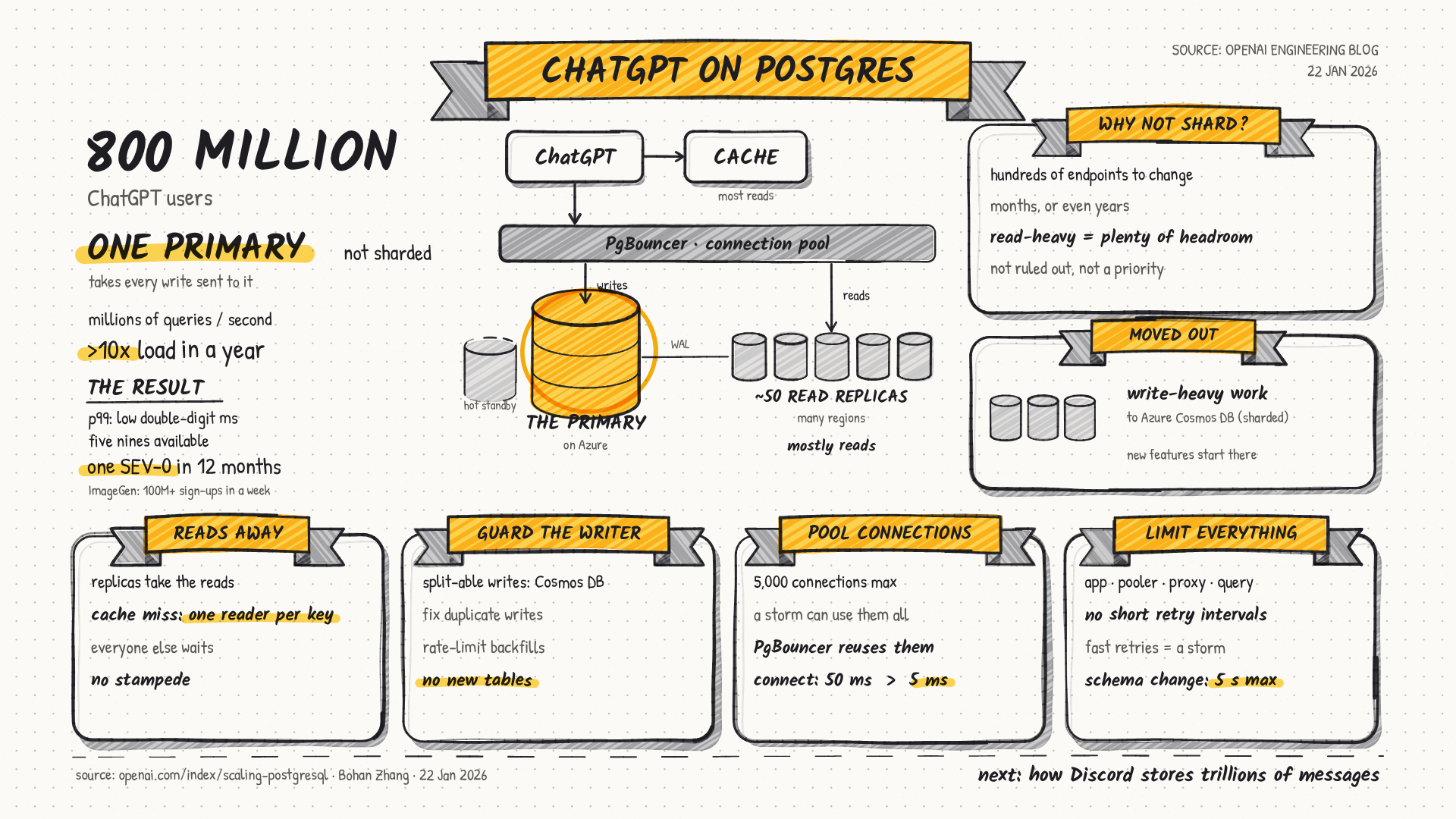
Save it for your next interview. I post one of these every week, each one a real system from a real company's own engineering blog.
- Watch it in 48 seconds: Instagram Reel
- Next week: how Discord stores trillions of messages.
Want to run a system like this yourself?
I'm building a game where you keep systems like this one alive while the traffic climbs: add replicas, place the cache, stop the stampede before it hits your one writer.
Source: OpenAI engineering blog, "Scaling PostgreSQL to power 800 million ChatGPT users", Bohan Zhang, 22 January 2026. I'm not affiliated with OpenAI; all figures are theirs.
About the author
curious developer from india .
Comments
Join the discussionNo comments yet. Be the first to comment.


